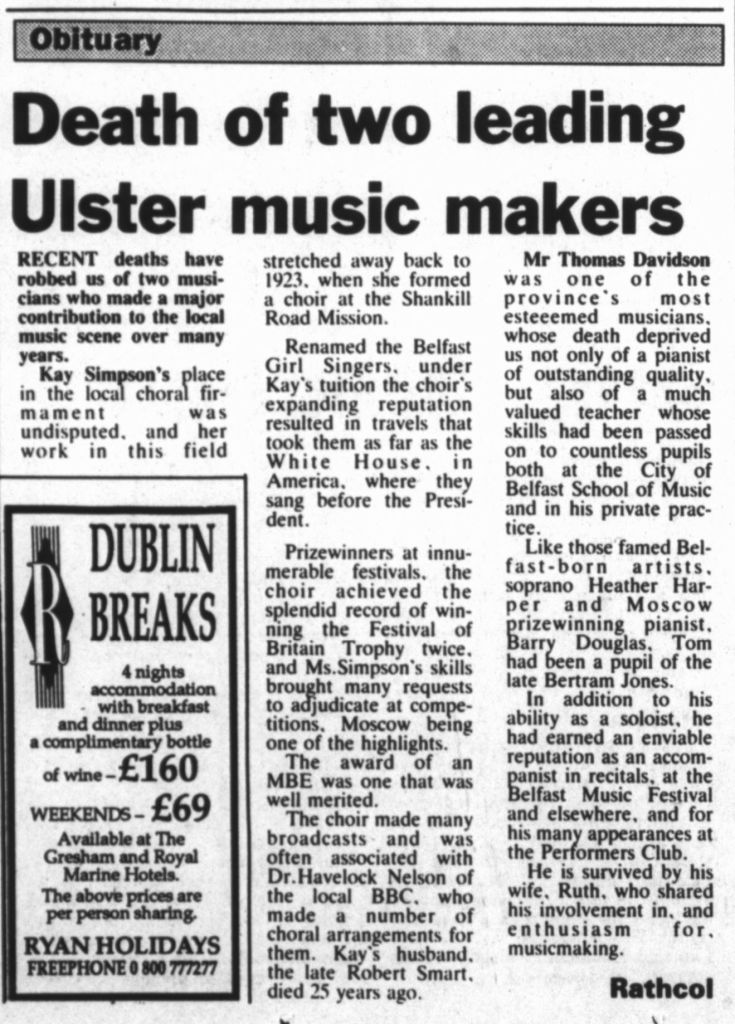
A Belfast Pianist
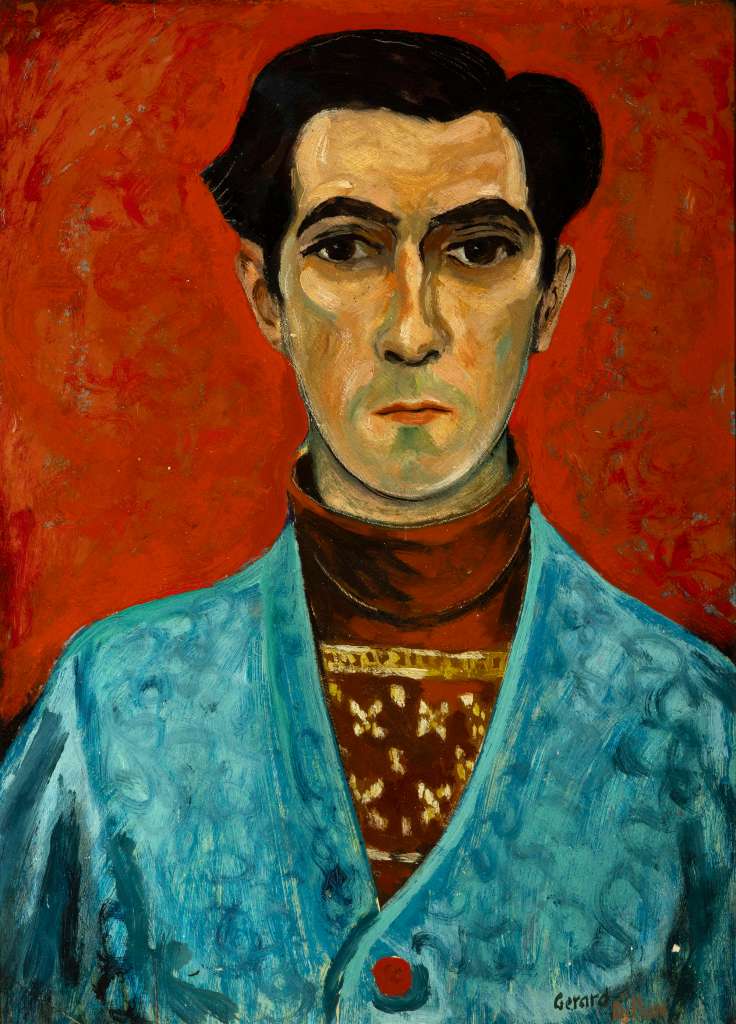
Tom Davidson was my great-uncle, although he belongs to a generation of my family which I knew more through stories, photographs and surviving papers than through direct memory. He was born in Belfast in 1927 and became a gifted pianist, studying with Edward Holmes and Bertram Jones before gaining his FTCL in 1946. During the 1940s and into the following decades he built a serious musical career as a recitalist and teacher, with musical connections extending well beyond Belfast.
This part of the website is an attempt to bring Tom’s story back together. Like many musicians whose careers were substantial without becoming nationally famous, he has left a scattered history rather than a convenient biography. There are recital programmes, newspaper notices, family recollections and other fragments which allow something of his musical life to be reconstructed.
My interest is partly personal. Tom was one of the musicians in my own family, and as a musician myself I naturally want to understand more about what he did, the world in which he worked and the sort of pianist he was. But I also think his story is worth recording in its own right. I do not expect this to be the last word on Tom Davidson. Quite the opposite. My hope is to assemble what I can find, distinguish what can be documented from what survives only as family memory, and gradually build a reliable account of a Belfast musician whose career deserves not to disappear simply because so little of it has yet been gathered in one place
Refelections
Louis MacNeice begins his poem Dublin with brick.
Not the emerald green of the tourist poster, nor the high heroic colour of rebellion, but “grey brick upon brick”: the ordinary substance of a city, built, weathered, inhabited. Bronze men declaim from sombre pedestals. The brewery tugs move upon the river. Swans drift beneath balustrades. A bare fanlight stands over a hungry door.
This is no love song in the easy sense. MacNeice will not flatter Dublin, yet neither will he dismiss it. He sees the glamour and the squalor, the talk and the pain behind the talk. The city is elegant, seedy, soft with rain, brutal in memory. It does not belong to him and yet it holds his mind.The later cry of his Autumn Journal is a fiercer still benediction on Ireland and Belfast in particular. There are drums in the night and inherited hatreds. There is the grocer drunk with the drum, the landlord shot in his bed, the weeping woman before the gaudy altar. There are patriots and traitors, martyrs and fools, banners enough to hide a multitude of sins. MacNeice looks upon the whole inheritance and will neither bless it nor entirely cast it off.
“Odi atque amo.” – I hate and I love. That is how one belongs to a place honestly.
I came from East Belfast. I do not need its faults explained to me by anyone. I know the airs, the inherited suspicions, the easy temptation to confuse loyalty with virtue. I know what happens when identity is no longer something one possesses but something one must continually perform. I also know what lay behind the doors. There were working men who took pride in making things properly. There were women who stretched wages and kept houses and somehow found money for books, uniforms and music lessons. There were families of modest means who recognised ability when it appeared in a child and did not ask whether genius had chosen the correct postcode.
There were pianos in ordinary rooms. There were books, sometimes far more books than the house could sensibly hold. There was argument. There was humour. There was loyalty of the sort which could be maddening and sustaining in equal measure. People were capable of narrowness. They were also capable of astonishing generosity. East Belfast was not an innocent place. No place is. But nor was it a spiritual desert from which any sensitive person must escape to become real. That distinction matters to me. Music was how I first moved outside the immediate world of my upbringing. I went where the music was. At eighteen, coming nineteen, I found myself conducting the Harlandic Male Voice Choir. It had grown from the world of Harland & Wolff and carried much of Protestant industrial Belfast within it. There was fellowship, pride, discipline and a marked suspicion of anything too precious. Emotion was permitted, provided no one was foolish enough to name it. Yet emotion was everywhere.
Men came from work and stood shoulder to shoulder. They learned notes. They quarrelled over tempi they did not know were called tempi. They breathed together. They discovered, sometimes to their own surprise, that thirty or forty ordinary voices could make a sound no single man among them possessed. They sang at funerals. They raised money. They travelled. They represented a city and a tradition which could be awkward, proud, wounded and generous. The concerts were only the public manifestation of it. Behind every concert lay Thursday evenings in that rehearsal room at St. Georges. There were mistakes, jokes repeated beyond endurance, music marked and remarked, words spoken too sharply, apologies made without quite being spoken, and those moments when a chord really came into tune and the room changed. That was where the real life of the choir happened.
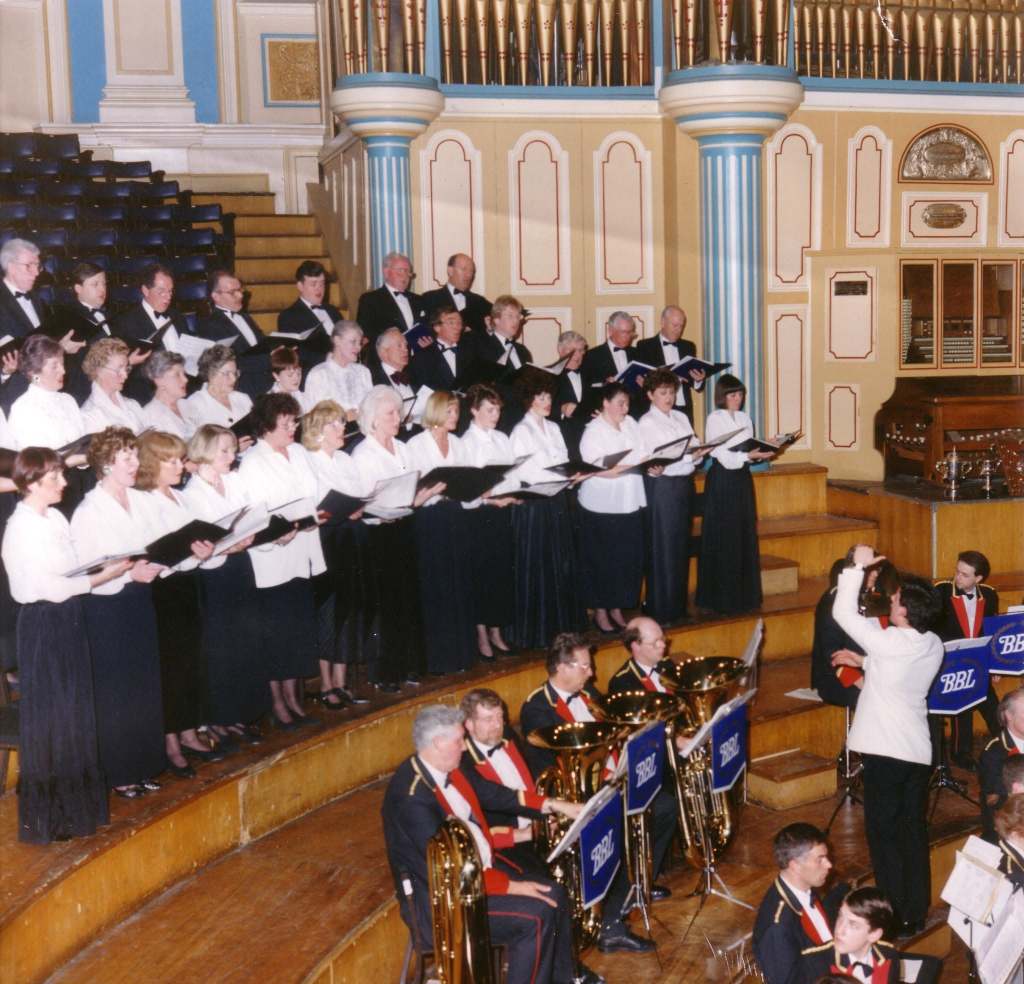
At much the same time I was working with St Agnes’ Choral Society from Andersonstown in nationalist West Belfast. I taught music at Dominican College, a Catholic girls’ school where I was conspicuously young, male and Protestant. I directed St Patrick’s Choral Society in Downpatrick. I sang as a lay clerk at St Anne’s Cathedral. Later I worked for RTÉ in Dublin and Limerick and depped in St Patrick’s cathedral choir in Dublin. I moved between those places without ever feeling that I had changed nationality at the traffic lights.
The people I met did not require me to cease being from East Belfast. They trusted me with their singers, their pupils and their music. Catholic institutions reached towards me as surely as I reached towards them. I entered other worlds, but I did not have to repudiate the first one before I was admitted. That has left me suspicious of stories which divide life too neatly. Protestant Belfast becomes narrow and life-denying. Dublin becomes sophisticated and humane. London represents freedom. Home represents fear. Industry is confinement; art is liberation. It is all far too tidy. The cosmopolitan can be provincial in its own fashion. Artistic circles have hierarchies, jealousies and cruelties as elaborate as any lodge room or church committee. Those who congratulate themselves upon their openness may be blind to entire cultures which they have never troubled to understand. Working people can be philistine. They can also make costly sacrifices for beauty..
MacNeice saw the danger of pigeon-holing the dead into patriots and traitors. We do something similar whenever we discover the one fact which appears to explain a person and then force all the other evidence through it. The successful man was ambitious. The performer who suffered anxiety was secretly incapable. The person who remained in his home city lacked courage. The one who left had rejected his people. Each proposition may contain a fragment of truth. That is what makes such stories dangerous. Falsehood seldom travels alone; it takes enough truth with it to gain admittance.
I have been thinking about all this because of my great-uncle, Thomas Davidson. Tom was my grandmother’s youngest brother. I remember him from childhood, though only in fragments. I remember going with my father to the house in Rugby Road. We entered, and there was the music room. A Steinway grand piano dominated it. Paintings seemed to cover the walls. I remember the atmosphere more readily than the arrangement: tobacco, books, paper and music, the peculiar stillness of a room in which much sound had been made.Memory is a strange housekeeper. It moves things about. It polishes one object and lets another gather dust. I cannot swear now that every smell belongs to that exact afternoon, but I can still summon the room. I saw it before it became history. The paintings were not yet auction lots, described by provenance and measured in thousands of Euros. They were simply Tom’s pictures. The Steinway had not been sold. It was still a working instrument. Singers came to the house. Pupils came. Music lay open upon the desk.
At my grandmother’s funeral, Tom appeared in black. He was tall and imposing, in a long coat with a cape and a great black hat. He looked entirely unlike everyone else. There was something theatrical about him. Cultivated too. Yet he did not look ridiculous, because he possessed the presence to carry it off. Some people wear clothes; Tom appeared to inhabit them.
The newspaper record has begun to restore him. Tom’s musical education took place in Belfast. He studied first with Edward Holmes, whose premises on the Woodstock Road stood only a short walk from Willowfield Parade. Later he became a pupil of Bertram Jones, one of the city’s most important piano teachers. By the age of eighteen or nineteen, Tom had gained the Fellowship of Trinity College London. He was giving recitals. He was teaching pupils from the family home. The programmes he played were not the careful selections of an agreeable amateur. The critics heard natural facility, imagination, warmth and individuality. They also heard impetuosity, as critics properly should. Their praise is the more convincing because it was not unqualified. They thought Belfast had produced a pianist of whom it might be proud.
What has surprised me is not simply the brilliance of the beginning. It is the continuity of the life that followed. Tom appears repeatedly through the surviving record; solo recitals, broadcasts, festivals, concerts with choirs, accompaniments for singers, appearances at the Performers’ Club. Across decades, the notices accumulate until they cease to look like isolated engagements and begin to reveal the shape of a working life.
A concert notice is a small thing. A few lines. A date. A venue. Names printed in diminishing order of importance. But I know what lies behind it. Before the public performance came practice. Before the singer stood beside the piano, music had been chosen, keys discussed, breathing considered. There were rehearsals. There was the stopping and starting, the pencil upon the page, the question of whether the phrase should move or wait. Father Eugene O’Hagan, later one of The Priests, remembers going to Rugby Road when Tom was accompanying him. They rehearsed there in advance.
It is a modest recollection. It tells us a great deal. The house was not merely a place where Tom retreated from the world. It was a place to which the musical world came. Every public appearance had other days attached to it. A song recital may have required several rehearsals. A choir concert had rehearsals stretching back through the weeks. Festival accompanying meant long hours at the piano, often with unfamiliar music and little time to prepare. Broadcasting required studio calls, balance checks and the peculiar concentration demanded by a microphone which hears everything and forgives nothing.
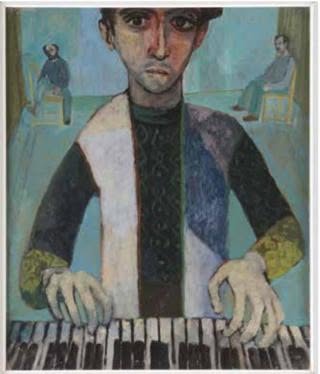
The printed notices are not Tom’s musical life. They are the visible crests of waves whose greater substance lies beneath the water. With more work, it may be possible to place him in Belfast through a remarkable proportion of his adult life. Not every day, of course, perhaps not every week, but often enough to establish a dense pattern of work, rehearsal and professional obligation. Tom made great music. Singers sought him out. Choirs engaged him. Broadcasters booked him. Pupils came for lessons. Other musicians trusted him with their work and remembered what he could do
There is a form of affection in musical collaboration which has no obvious name. A singer entrusts the line to the pianist. The accompanist listens for breath, anticipates fear, holds back, moves forward, catches the faltering entry and makes it appear intended. He is present without intrusion. At its best, accompaniment is an act of generous attention.
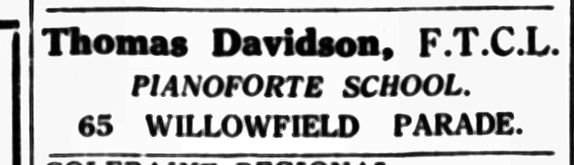
Teaching is similar. The pupil brings awkwardness into the room, together with vanity, anxiety and hope. The teacher listens. He demonstrates. He says the same thing for the seventh time in another way. .
Tom’s father, Andrew Davidson, worked at the Sirocco Works for an extraordinary length of time and received the British Empire Medal for his service. He was a member of the Orange Institution and the Royal Black Institution. Those facts allow a certain sort of unsympathetic imagination to construct him immediately: stern, sectarian, industrial, the embodiment of everything from which the artistic son must escape.
Years of piano lessons cost money. So did examinations, music and the instrument itself. In a large working family, Tom’s development required sustained consent and sacrifice. His talent did not flower despite his home. It flowered partly because of it. That does not make Andrew a saint. We are none of us in danger of sainthood. It simply requires that he be restored from emblem to man. The family home also received people from another religious and artistic world. Again, this proves no general enlightenment. It does show that identity and hospitality could inhabit the same house. People are often larger than the institutions to which they belong.
I learned this repeatedly while working on the history of the Harlandic Male Voice Choir. Choirs develop legends. Stories are told until the rhythm becomes fixed and the date less important. Someone remembers a first victory which turns out not to have been the first. A quarrel becomes an estrangement of fifty years, until a newspaper photograph shows both men sharing a platform. Memory is not worthless because it errs. Often it preserves the emotional truth of an event while mislaying the particulars. Documents err differently. Minutes tell us what was recorded, not everything that happened. Newspapers notice the concert but not the rehearsal. Photographs show who stood in the front row and conceal who had left the room in tears five minutes earlier.
The historian must work between them. My Civil Service life taught me to ask what the evidence can properly bear. What is established? What is reported? What is inferred? What remains unknown? Those questions may sound dry. They are, in fact, moral questions. The dead have no right of reply. They cannot object when we make them simpler than they were. They cannot remind us that a statement was made in anger, or that a grief which lasted all their lives did not fill every hour or anything like it.
They cannot tell us what they did and left undone. We therefore owe them the discipline of evidence. We also owe them mercy. Not the mercy which suppresses what is difficult. That is sentimentality, and sentimentality is often another form of dishonesty. The mercy required is the willingness to leave contradictions unresolved when the truth does not permit resolution.
MacNeice wrote of the hope that, upon a tiny stage, a man might “see the end of one particular action”.I understand that hope. The local work matters because it can be completed. A choir learns the piece. A pupil masters the passage. A singer arrives frightened and leaves ready. A concert happens on a wet Tuesday in Belfast and is remembered by someone thirty years later.
Not everything of value must be at the world’s mercy. Harlandic mattered. Its rehearsals mattered. The men who sang were not inferior because their work was local. Tom’s work at Rugby Road mattered. They went because he could help them. The wish to find one hidden truth behind a person is understandable. F. Scott Fitzgerald understood the allure of the self-invented in pursuit of a dream, and the ache of discovering that the dream cannot quite bear the weight placed upon it. Louis MacNeice understood the pull of the country repudiated but never escaped. Shakespeare understood that a man may “smile, and smile” without the smile revealing the whole.
The Bible is less surprised by contradiction than we are. Saint Paul does what he would not, and leaves undone what he would do. The psalmist praises in one breath and laments in the next. Job refuses the explanations offered by tidy men. Human beings have always been divided countries. Perhaps that is why Tom has taken such a hold upon me. We share blood, though blood alone explains little. We share East Belfast. We share music and the peculiar experience of achieving public authority before private certainty has caught up. We both moved between cultural worlds. We both lived at home longer than a simple story of independence might approve. I do not claim that this gives me access to Tom’s heart. It gives me access to some of the questions.
I know what lies behind a concert notice. I know that teaching is not necessarily what a performer does when performance has failed. I know that a local career may be exacting, useful and honourable. I know that a man can put on a front without becoming false. There are fragments of me in each description. I am not contained by any of them. Why should Tom be? The task is not to vindicate him. Nor is it to remove sadness from the account. “In the midst of life we are in death,” says the burial service, and every long life acquires its losses. The task is to let the life remain alive. Belfast was grey brick, industrial smoke, rain, flags and argument. It was also music behind ordinary doors. Tom was an amazingly gifted pianist. He was a teacher, accompanist, broadcaster, son and husband. He was a man who loved and was deeply loved. He performed. He helped others make music.
I have spent much of my life standing before separate voices and persuading them to inhabit the same music. A choir does not become beautiful because every voice is made identical. The bass must remain a bass. Dissonance is not an error merely because it aches. Sometimes it is the thing which gives the resolution meaning.
History should aspire to something similar. Not a comfortable unison. A truthful harmony. MacNeice ends Dublin with greyness running to flower: grey stone, grey water, brick upon grey brick. The stone remains grey. The rain has not ceased. No false sun has appeared to redeem the city. Yet something flowers. That may be the most we can honestly say of a place, a family, or a human life. The greyness was real. So was the flowering.
There will, I think, be two accounts of Tom when this work is done. One will be the public book: the life and achievements of one of Belfast’s greatest pianists and most musical sons, assembled from programmes, reviews, broadcasts, recollections and the patient recovery of a working life. It should be candid. It must not turn aside from sorrow, weakness or contradiction. Yet it will not contain everything, because not everything that is true must be exposed to every passing eye. There are confidences which illuminate a life but would add little to its public telling; memories too intimate to print; family stories which may carry truth without possessing the firm footing required of history. “There is a time to keep silence, and a time to speak.” The judgement lies in knowing which time has come.
The rest will remain in the family history box: letters, notes, photographs, private recollections, conflicting testimony and those small fragments which resist the smooth line of narrative. That is not a second, secret biography, still less a cupboard in which inconvenient truths are hidden. It is an act of stewardship. The book will say what can responsibly be established and fairly made public. The box will preserve something more for those who come after us and care enough to look; who said what, what was remembered, what was inferred, and what remains beyond our knowing. Perhaps, many years from now, another family member will open it and find not merely the celebrated pianist or the mysterious man in the cape, but some nearer sense of the human being who practised, taught, loved and went on making music.
That gathering matters now because memory has its own mortality. The people who heard Tom play, studied with him, rehearsed at Rugby Road or knew the stories at first hand will not always be here. Houses are cleared. Names disappear from the backs of photographs. A concert programme which once seemed too ordinary to keep becomes, in another generation, the sole surviving witness to an evening of music. To collect these things is not to embalm Tom, nor to lay final claim upon him. It is to place what remains in some kind of order before the tide comes in, trusting that the public account and the private inheritance may together preserve a life which neither could contain alone.