A Belfast Legend and Institution
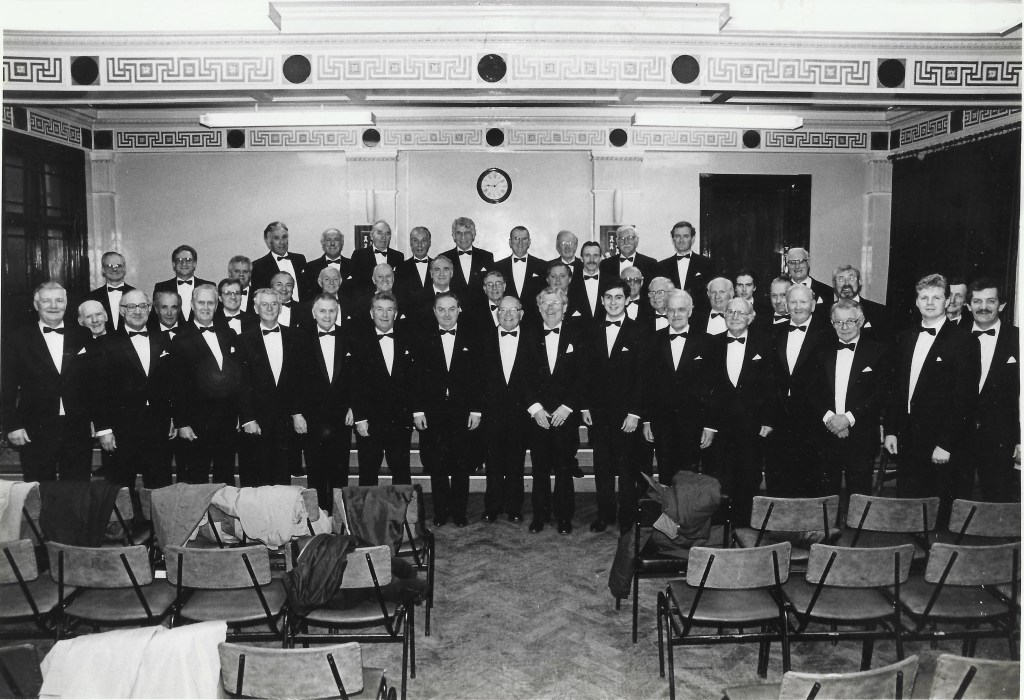
The Harlandic Male Voice Choir has been part of my musical life for more than thirty years. I first became its conductor when I was nineteen, an absurdly young age to find myself standing in front of a long-established Belfast male choir, many of whose members had been singing together since before I was born. I stayed for ten years. They were important years for me as a musician and conductor, but they also gave me a lasting affection for the choir itself. We rehearsed every week, made broadcasts and recordings, toured, competed and gave concerts throughout Northern Ireland and beyond. I learned a great deal from those men, probably rather more than they realised at the time.
My interest in the Harlandic has never really gone away. As the years have passed, I have become increasingly fascinated by what the choir represented as well as by the music it made. Its story belongs to Belfast and to the industrial communities from which male-voice singing grew. It is a story about work, friendship, aspiration and changing ideas of what it meant for men to make music together. I am now trying to recover and write that history while the records, recordings and memories still allow us to do so. What follows is the beginning of that work.
From the Works Fire: the Origin of the Harlandic Male Voice Choir
The Harlandic Male Voice Choir began in the working world of wartime Belfast. Its first setting was not a concert platform, church hall or musical society room, but the Harland and Wolff works: the Victoria Works, Queen’s Island, where men sang during the meal hour in the latter days of the war.[1] The choir’s own foundation tradition placed the moment in late November 1944, around a coke fire, during a lunch-time break from twelve-hour wartime shifts.[2] That account is retrospective, and it must be handled as institutional memory rather than as a surviving contemporary minute. Yet it is not a loose legend floating free of evidence. The earliest public record so far identified places the Harlandic Male Voice Choir before an audience by May 1945, still closely tied to Harland and Wolff workers and wartime civic entertainment.[3]
The foundation story has power because it gives the choir a social origin as well as a musical one. Men who worked with machinery, metal, heat, time and discipline began to sing together in the pauses of industrial labour. The first rehearsals, according to the internal account, were not arranged at some comfortable remove from the yard. They were fitted into the working day, in an outside air-raid shelter made available during meal breaks. One of the members, Norman K. Fitzsimmons, agreed to act as conductor.[4] That detail is central. Later memory, understandably, allowed Adam Donaghy’s immense later importance to draw him backwards towards the origin. The evidence does not permit that. Fitzsimmons belongs at the beginning.
The name also has to be treated carefully. By the time the choir enters the public record in May 1945, it is already Harlandic Male Voice Choir.[5] The word “Harlandic” derived from Harland and Wolff’s telegraphic address, and its adoption expressed more than convenience. It attached the choir to the shipyard’s identity while allowing the singers to become something more than a workplace amusement.[6] Yet there is now good reason to believe that Harlandic was not the first name by which the group knew itself. In 1984, when the Belfast Telegraph marked the choir’s fortieth anniversary, the surviving founder members Bill Caldwell and Bob Jeffrey recalled that the group had first called itself the “Embassy Choir” before Harland’s gave permission for the use of the telegraphic address “Harlandic”.[7] That testimony, standing alone, would need caution. The same anniversary article contains chronological errors about the early competition record. But the Embassy memory is supported by surviving music-library evidence from the choir itself: scores stamped “Embassy Male Voice Choir” in italic dark-blue ink, alongside other scores stamped “Harlandic Male Voice Choir” in the same style and ink.[8] That does not yet fix the exact date of the change, but it makes the Embassy name much harder to dismiss as a retrospective slip.
The first firm press sighting comes on 22 May 1945. The Northern Whig reported a Civil Defence “G” District variety week at the Empire Theatre, Belfast, in which Harland and Wolff workers supplied the larger part of the entertainment. The Harlandic Male Voice Choir was named among the performers, alongside the mixed world of singers, dancers, jugglers, ventriloquists and other variety artists.[9] The proceeds were for the Belfast Civil Defence Hospital Bed Fund and the Civil Defence Association Benevolent Fund.[10] This matters. Harlandic first appears in the record not as a polished festival choir, but as a works-born group singing in a wartime charitable context. Its earliest public identity was civic, practical and communal.
By April 1946 the choir had acquired formal structure. The Belfast Telegraph reported the second annual meeting of the Harlandic Male Voice Choir at the Carlton Restaurant, Belfast. The officer list is one of the key early documents. G. Balmforth was president; F. Heaney, J. Skillen, R. Martin and W. Smith were vice-presidents; N. K. Fitzsimmons was conductor; T. Cranston was chairman; W. Caldwell vice-chairman; G. McGladdery secretary; J. McClements assistant secretary; J. Eagleson treasurer; Mrs E. Fitzsimmons librarian and pianist; and W. McGladdery and J. Patterson committee members.[11] This is not a casual singing circle. Less than eighteen months after the remembered works-fire beginning, Harlandic had officers, a committee, a treasurer, a secretary, a librarian, a pianist and a conductor.
Fitzsimmons is confirmed again in August 1946. A Northern Whig sympathy notice headed “Harlandic Male Voice Choir” recorded that the officers and members regretted the death of Mr J. Fitzsimmons, father of their “esteemed Conductor”, Mr N. K. Fitzsimmons. The notice was signed by Geo. McGladdery, secretary.[12] That notice is small, but its evidential value is large. It proves that Fitzsimmons was still conductor in August 1946, and that McGladdery remained secretary. It also shows the choir acting publicly as an organised body of “officers and members”.
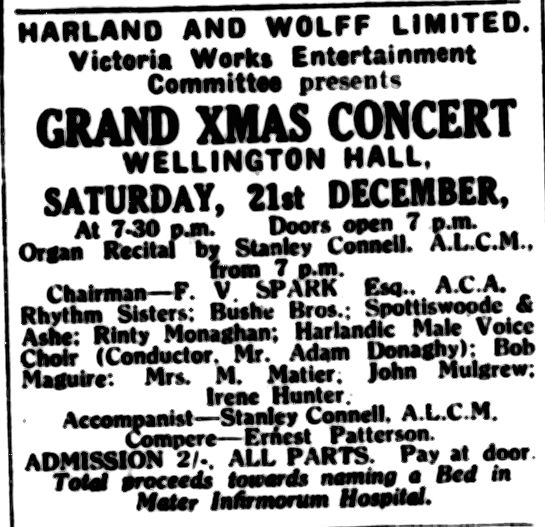
The transition to Adam Donaghy therefore falls between August and November 1946. On 18 November the Belfast Telegraph reported a Harlandic social at the Whitehall Restaurant, with T. Cranston presiding and the choir appearing under its conductor, A. Donaghy. Mr and Mrs Donaghy were also among those contributing to the programme.[13] A month later, on 21 December 1946, the Victoria Works Entertainment Committee advertised a Grand Christmas Concert at the Wellington Hall, with the Harlandic Male Voice Choir conducted by Mr Adam Donaghy. The concert was again charitable, with proceeds towards furnishing a bed in the Mater Infirmorum Hospital.[14] The sequence is now clear enough for careful publication: Fitzsimmons was the first or earliest documented conductor; Donaghy was certainly in post by November 1946; the exact appointment date remains unresolved.
The first securely evidenced competition success came in April 1947, not 1945. At Larne Musical Festival, Harlandic won the Fred English Memorial Challenge Cup with 169 marks, ahead of Carrickfergus Male Voice Choir on 168 and Ballycarry Male Voice Choir on 161. Kenneth Roberton adjudicated and praised Harlandic’s singing, phrasing, easy flow and blend.[15] Newry followed almost immediately, with Harlandic winning the male voice class on 178 marks, ahead of Willowfield Male Choir on 174.[16] These results mark the choir’s entry into the organised festival culture of Ulster. The men who had sung in the works were now standing before adjudicators and winning.
The May 1947 annual meeting shows how rapidly that success was absorbed into the life of the society. The cups won at Larne and Newry were handed over to the president by chairman T. Cranston, and Adam Donaghy received a cigarette case from the members. The officer list for that year included not only president, vice-presidents, chairman, vice-chairman, secretary, assistant secretary, treasurer and committee, but also librarian, musical committee, trustees, auditors, conductor and deputy conductor.[17] That structure matters as much as the trophies. Harlandic was already learning how to sustain itself: musically, administratively and socially.
The origin, then, should not be reduced to a single anecdote. It is a layered history. At its base is the shipyard memory: men singing round a fire in the Victoria Works, finding a voice together inside the rhythms of war work. Around that memory is the early organisation: the air-raid shelter rehearsals, the Embassy/Harlandic name-change tradition, the adoption of the Harland and Wolff telegraphic identity, and the movement from informal fellowship to structured society. Then comes the documentary spine: public appearance by May 1945; Fitzsimmons as conductor in April and August 1946; Donaghy in post by November 1946; and first secure competition victories in April 1947.
That is a stronger story than the simplified version. Adam Donaghy did not found Harlandic out of nothing. Nor was the choir merely a company ornament. It was made by shipyard men, formalised by shipyard men, and then transformed musically under Donaghy. Its origin lay in work, war, fellowship and sound; its first achievement was not simply that it sang, but that it organised itself well enough to endure.
Notes
[1] Harlandic Male Voice Choir, internal foundation account / programme history, copy or transcript supplied by Mark Burstow; see also the later retrospective origin tradition preserved in Alan Whitsitt, “The Harlandic—celebrating 40 years of close harmony,” Belfast Telegraph, 5 May 1984
[2] Harlandic Male Voice Choir, internal foundation account / programme history, recording late-November 1944, Victoria Works, coke fire, lunch-time singing, twelve-hour shifts and air-raid shelter rehearsals. Source supplied by Mark Burstow
[3] “Civil Defence ‘G’ District variety week,” Northern Whig, 22 May 1945
[4] Harlandic Male Voice Choir, internal foundation account / programme history, supplied by Mark Burstow.
[5] Northern Whig, 22 May 1945.
[6] Harlandic Male Voice Choir, internal foundation account / programme history; Alan Whitsitt, “The Harlandic—celebrating 40 years of close harmony,” Belfast Telegraph, 5 May 1984.
[7] Whitsitt, “The Harlandic—celebrating 40 years of close harmony,” Belfast Telegraph, 5 May 1984. The article identifies Bill Caldwell and Bob Jeffrey as surviving founder members and records their recollection of the “Embassy Choir” name.
[8] Mark Burstow, personal observation of surviving Harlandic music-library material: scores stamped “Embassy Male Voice Choir” and “Harlandic Male Voice Choir” in matching italic dark-blue ink.
[9] Northern Whig, 22 May 1945.
[10] Northern Whig, 22 May 1945.
[11] “Second annual meeting at Carlton Restaurant,” Belfast Telegraph, 1 April 1946. McGladdery; J. Patterson.
[12] “Harlandic Male Voice Choir,” sympathy notice for Fitzsimmons, Northern Whig, 10 August 1946.
[13] “Harlandic social at Whitehall Restaurant,” Belfast Telegraph, 18 November 1946. T. Cranston presided; choir under A. Donaghy; Mr and Mrs Donaghy among contributors; J. Bates pianist.
[14] Ireland’s Saturday Night, 14 December 1946, p. 4, advertisement, “Harland and Wolff Limited, Victoria Works Entertainment Committee presents Grand Xmas Concert, Wellington Hall, Saturday, 21st December.”
[15] Belfast News-Letter, 17 April 1947, p. 4, “Larne Festival: Awards in instrumental music classes”; see also Larne Times, 24 April 1947, p. 8, Larne Festival report.
[16] Northern Whig, 23 April 1947, p. 5, “Festival awards”; see also Newry Reporter, 26 April 1947, p. 8, Newry Musical Festival results.
[17] Northern Whig, 13 May 1947, p. 3, “Harlandic Male Voice Choir.”


